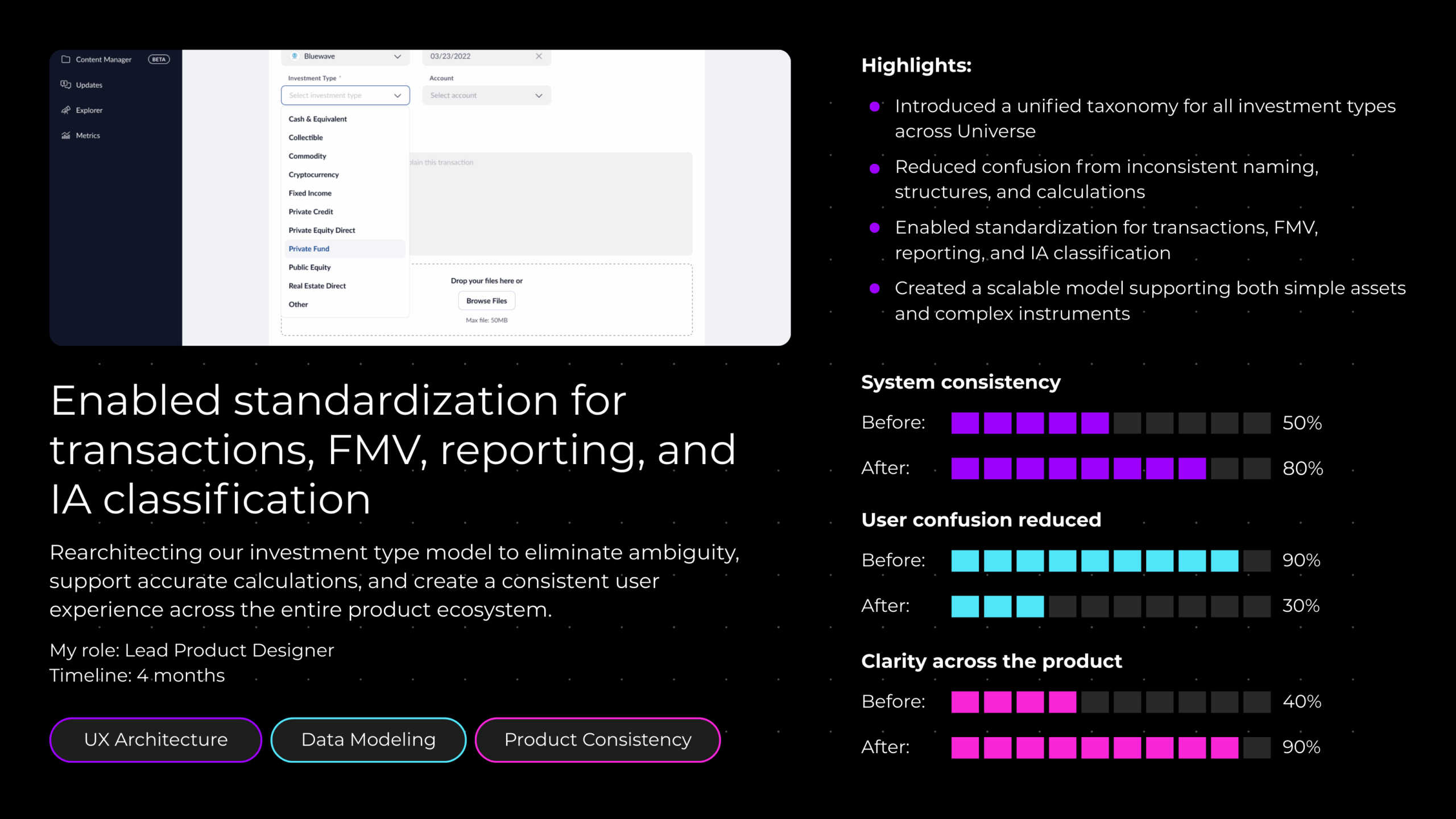
PROJECT SNAPSHOT
FULL CASE STUDY
Overview
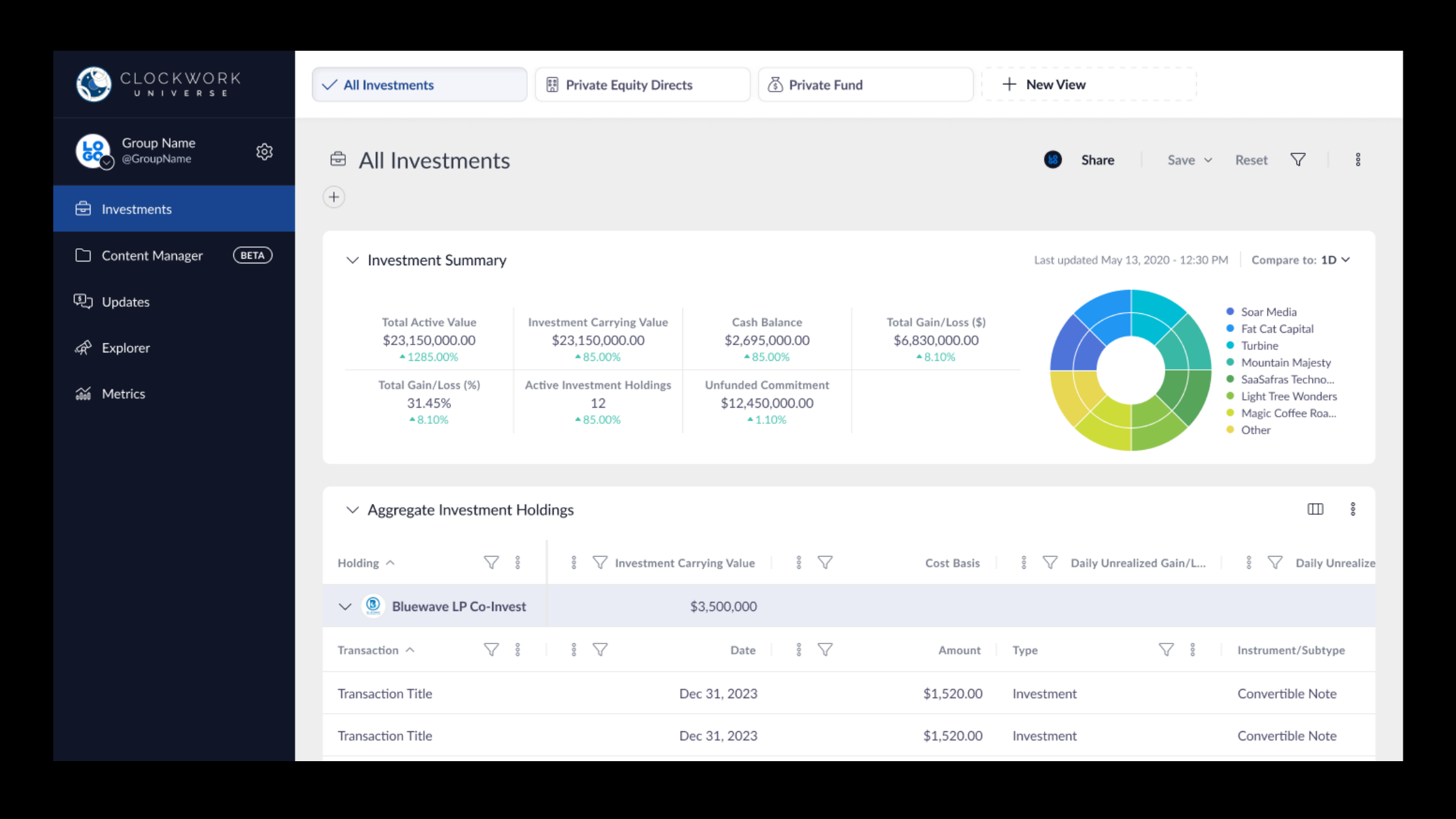
Clockwork Universe was initially structured around private-market investments (direct equity, funds, SAFEs, notes, etc.). This matched the needs of our early clients, who primarily managed private portfolios.
As the platform grew, a new segment emerged:
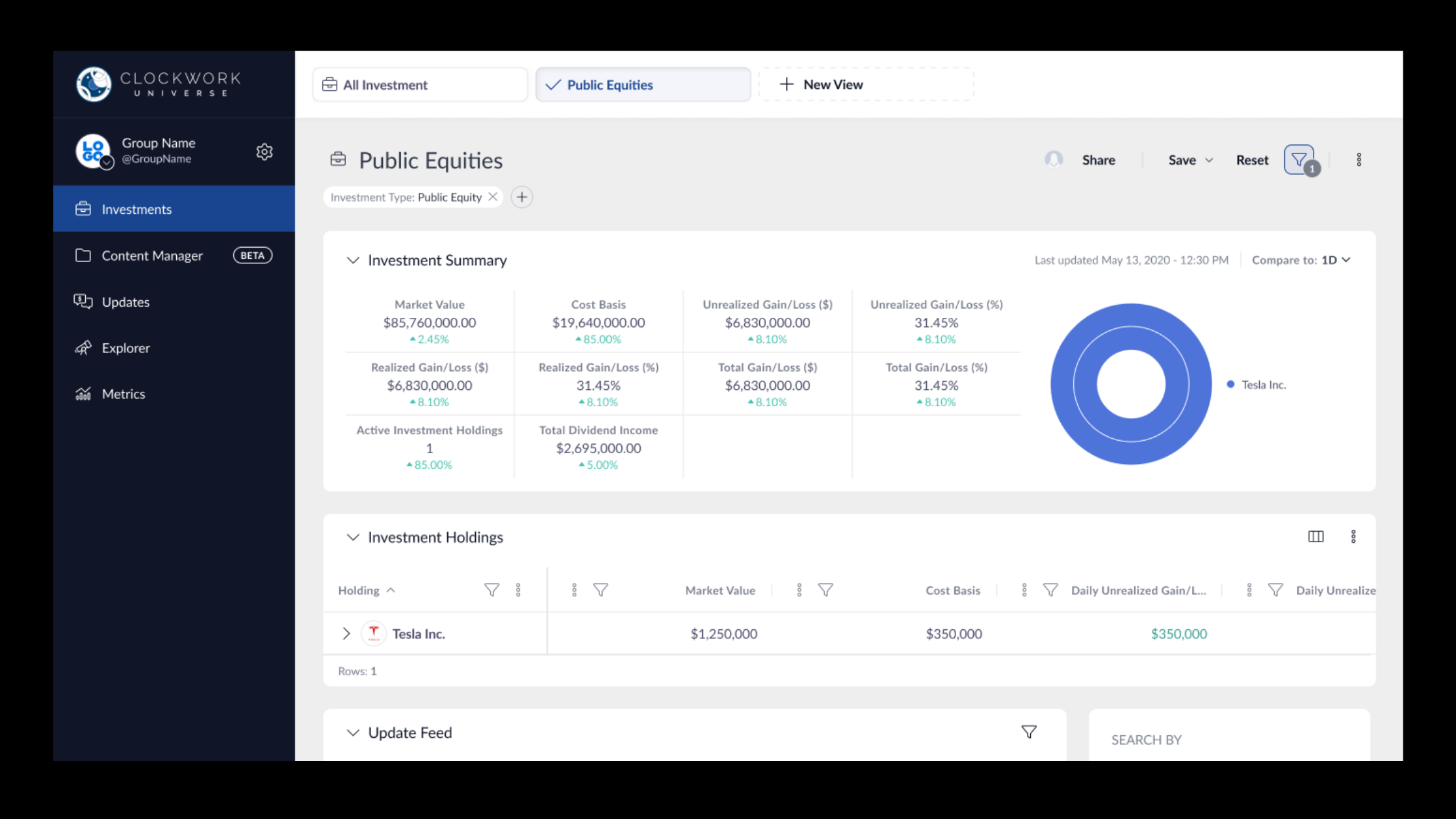
Wealth managers, multi-family offices, and hybrid investors who needed to centralize their entire investment universe, including public assets, real estate, alternatives, commodities, and cash positions.
This shift created a strategic need:
But the existing investment type structure wasn’t built for that. It lacked the categorization, clarity, and scalability required for a diverse portfolio.
The problem
Universe needed a clean, intuitive, and scalable investment type architecture capable of supporting any asset class, now and in the future.
My role
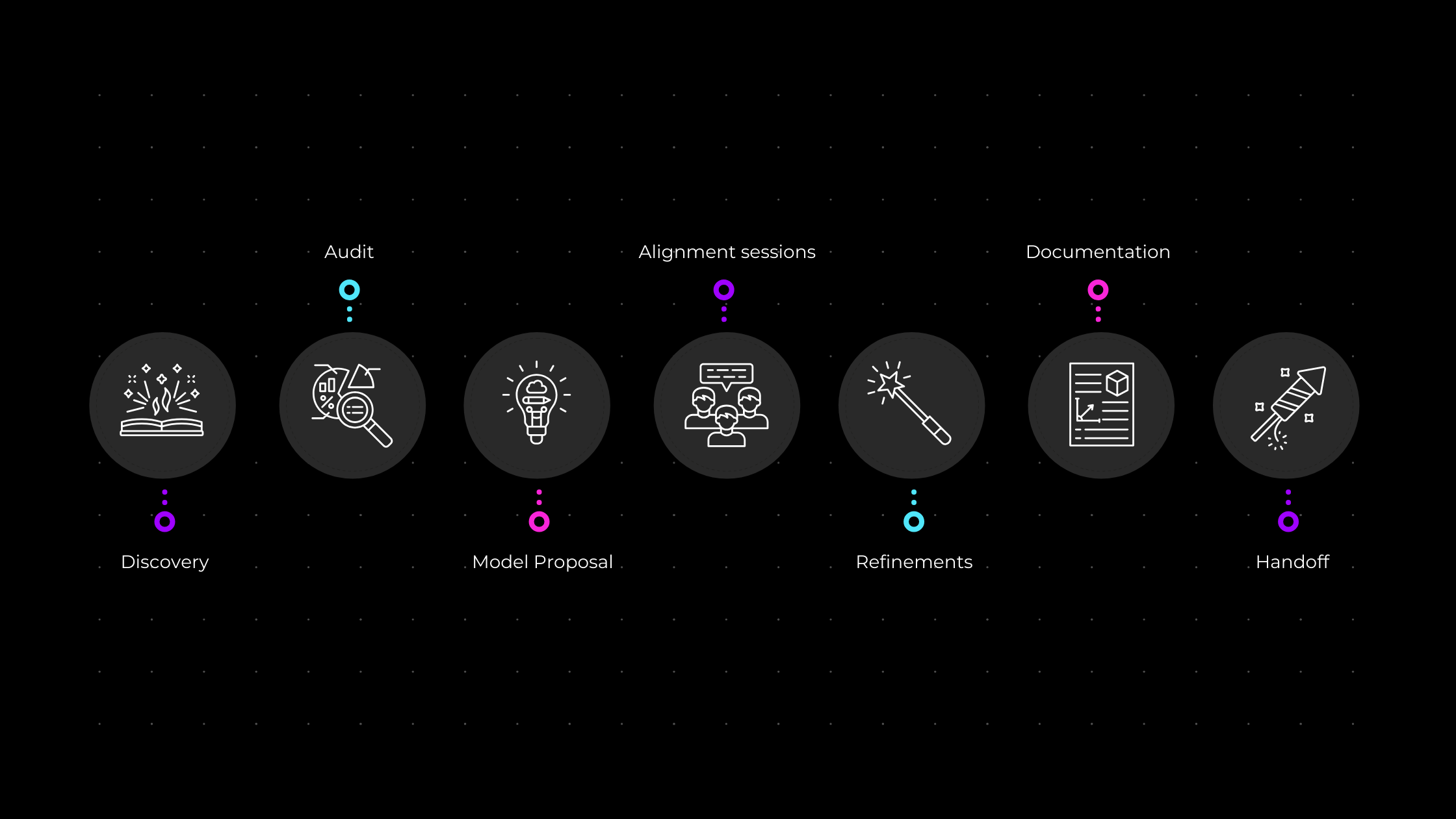
As Product Design Lead, I owned the redesign end to end:
This work required systems thinking, product strategy, and cross team facilitation, not only UI design.
Cross-functional alignment
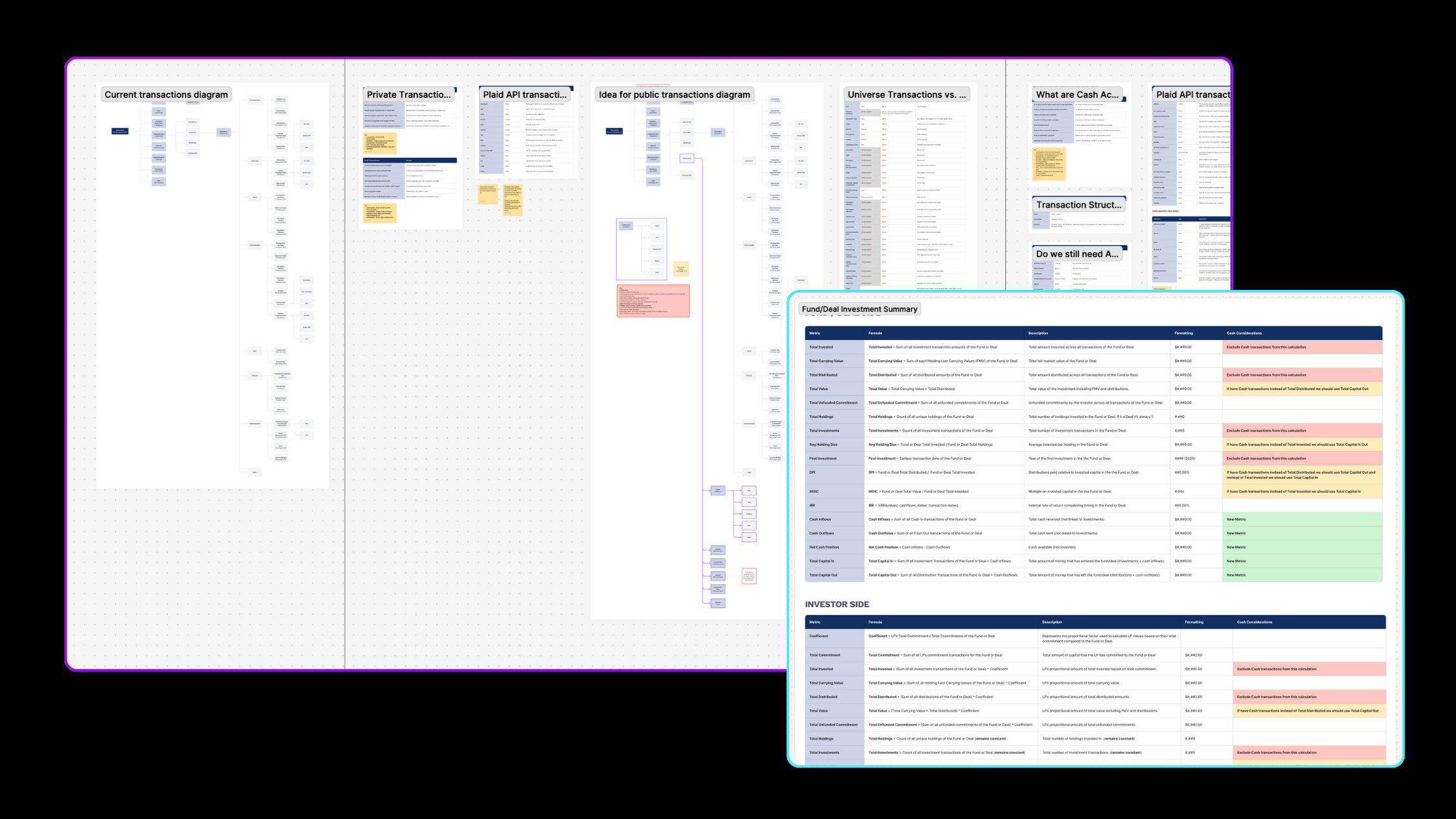
This project required coordinating across Product, Engineering, Investment Solutions, and Customer Success. I facilitated alignment sessions to clarify terminology, resolve conflicting interpretations, and ensure every team was working from the same conceptual model.
By leading these conversations, design became the central point of shared understanding, allowing the organization to move forward confidently with a unified investment framework.
Design principles
I guided the redesign using three core principles:
These principles shaped every decision and helped transform a legacy taxonomy into a coherent system.
The solution: A unified investment type framework
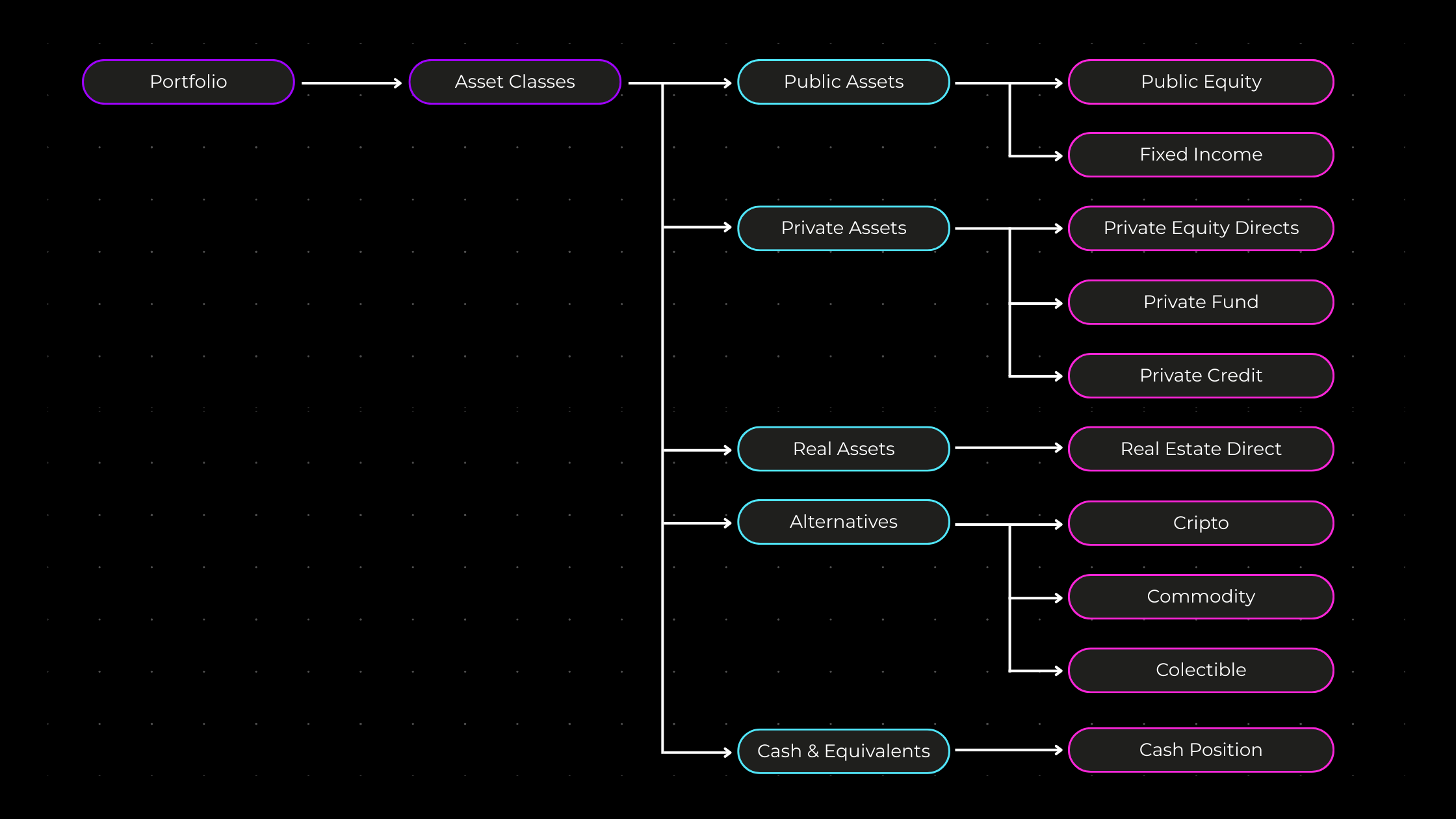
I redesigned the taxonomy into a single, scalable model aligned with real-world portfolio structures.
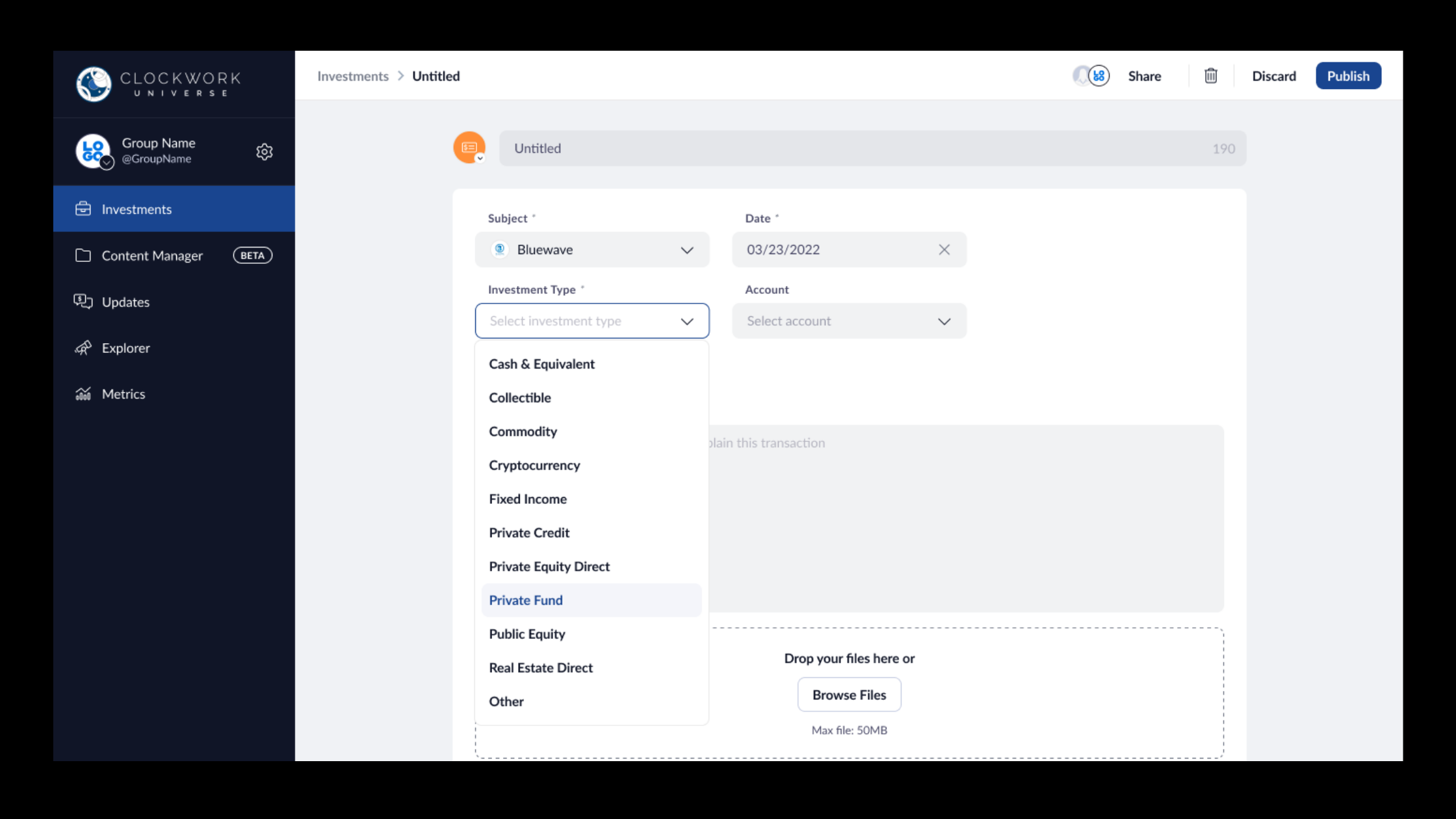
New Investment Types
Why this model works
More intuitive for users
It mirrors the asset classes clients already use in their real portfolios.
Consistent across the platform
The new types follow shared rules in:
Scalable for the future
New instruments or asset categories can be added without reworking the system.
Aligned with industry standards
Matches how wealth managers and investment teams classify portfolios.
How the model integrates across Universe
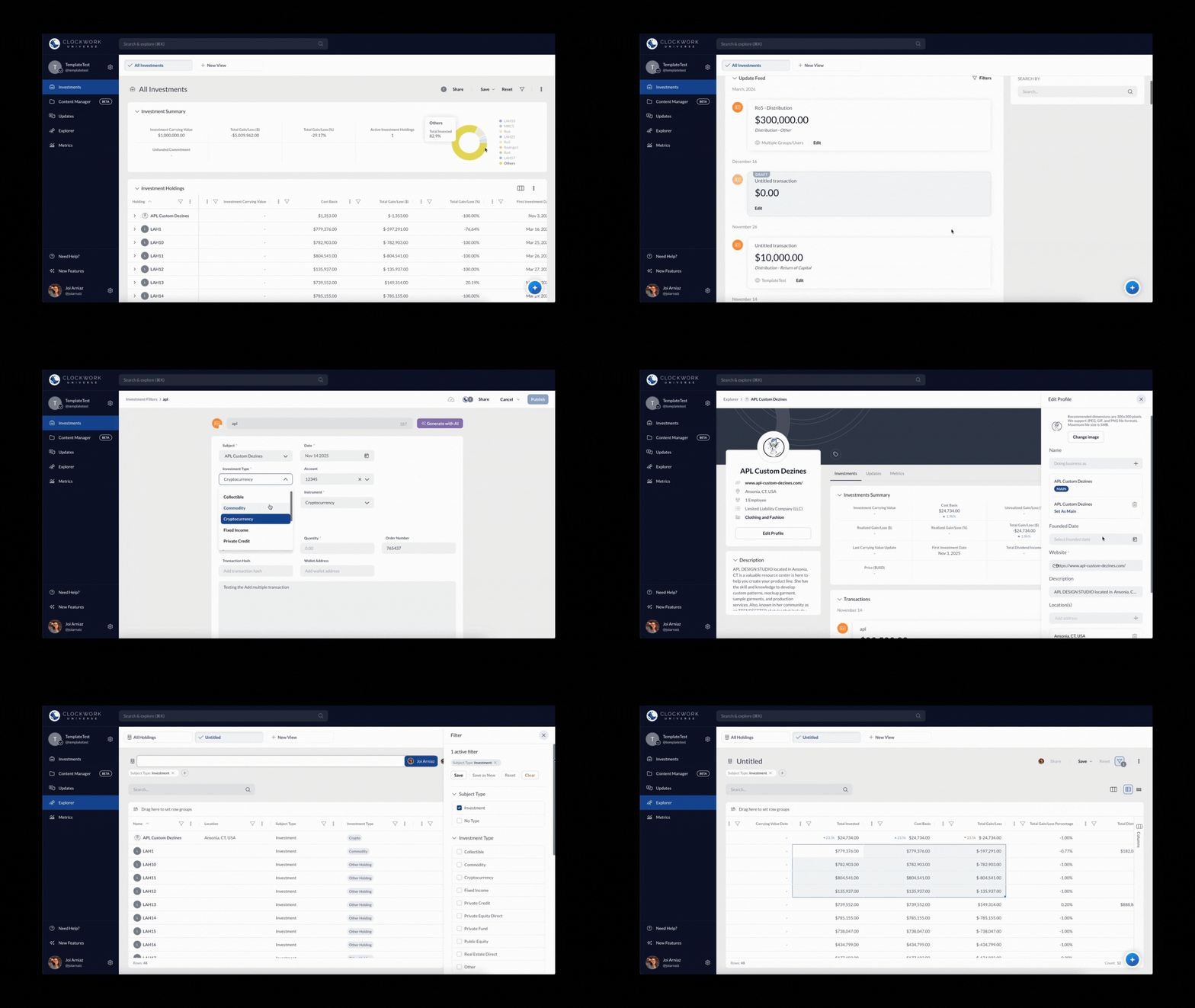
I defined the behaviors and interactions of investment types in all core modules:
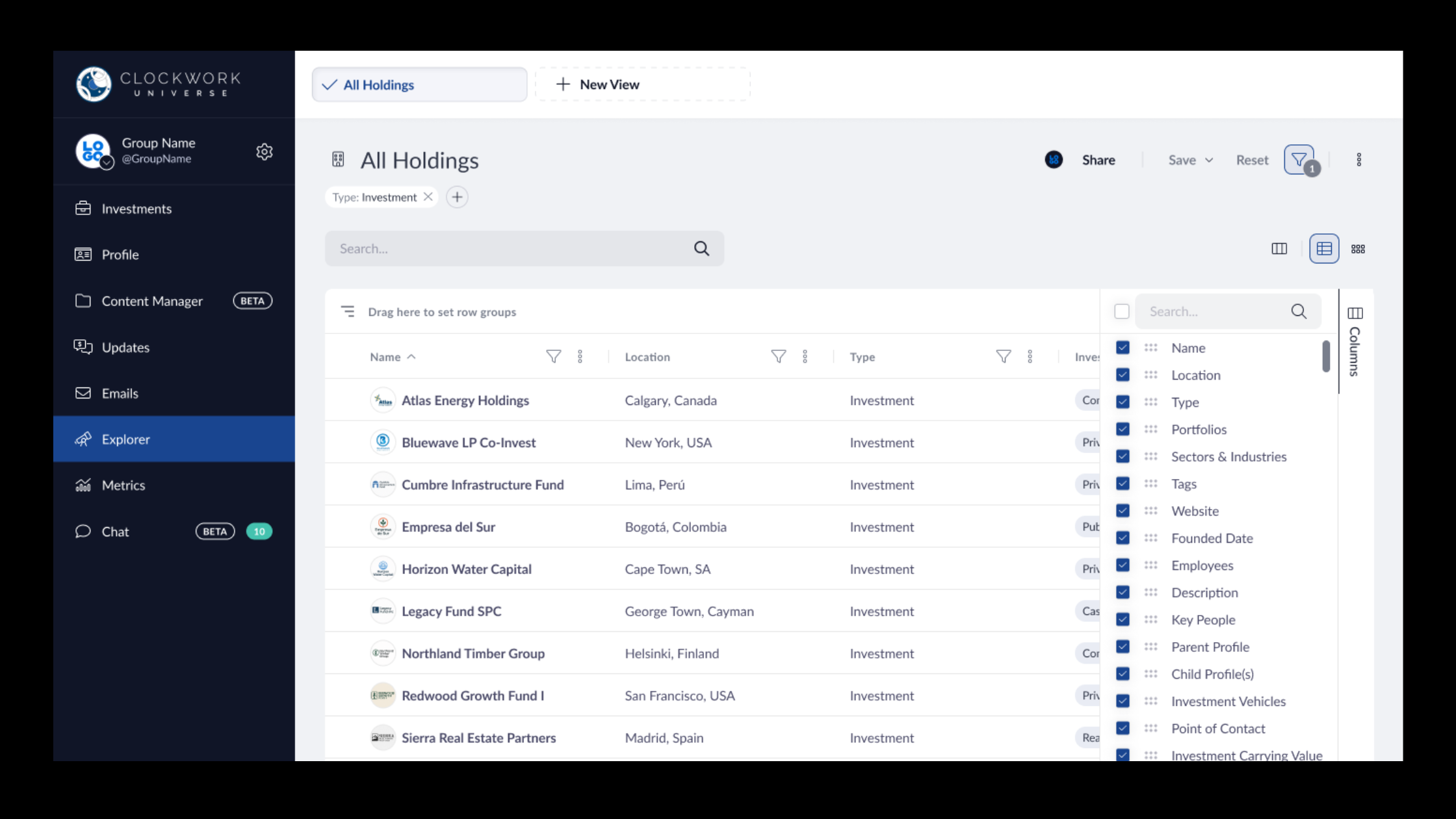
Explorer
Holdings
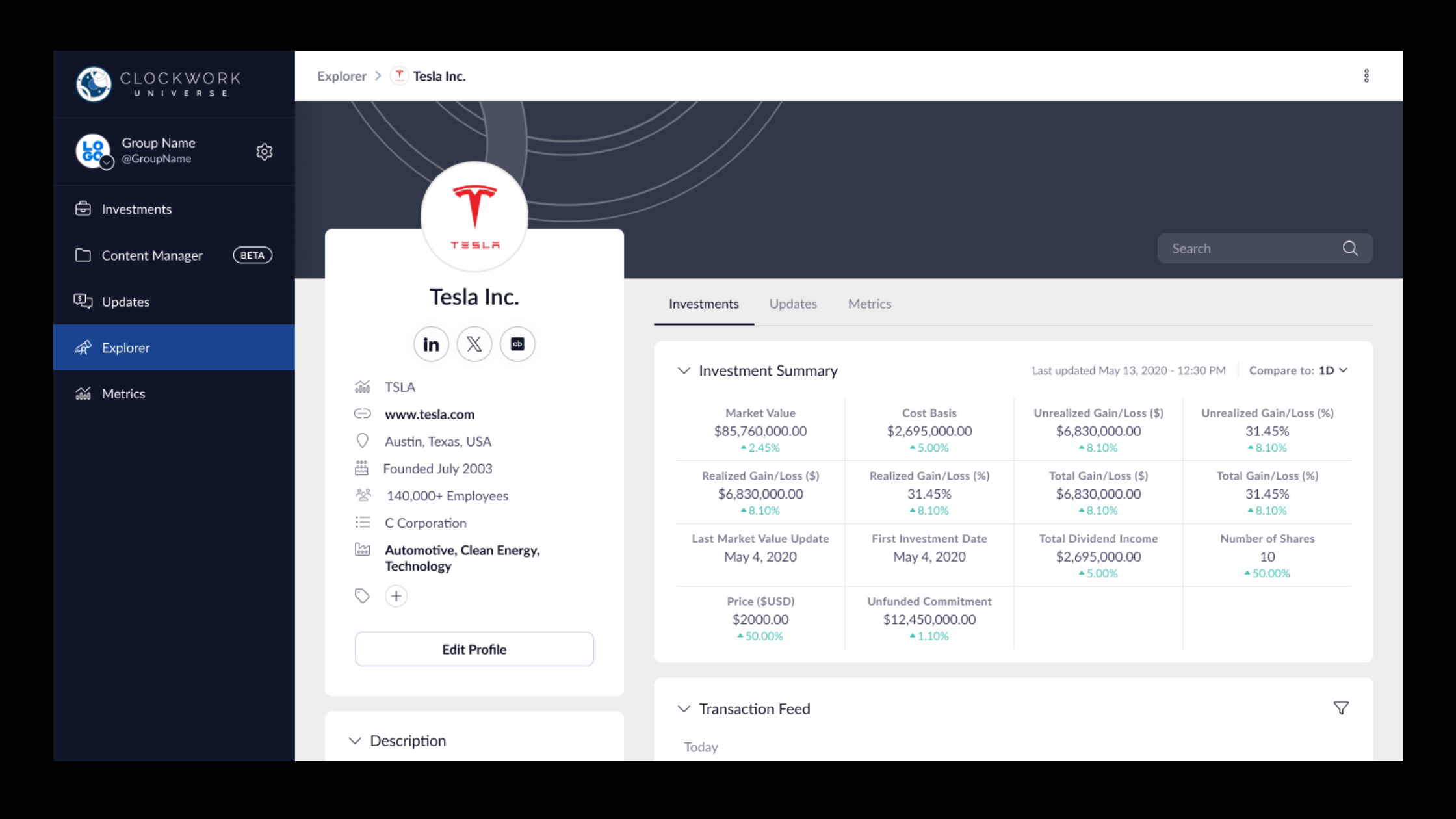
Investments Module
Reporting
Impact
For Users
For the Business
For the Product Team
Organizational impact
Beyond improving product consistency, this work created a shared language across teams.
The new taxonomy now serves as a foundation for engineering, analysts, CS, and Product, reducing ambiguity in daily workflows and enabling smoother decision making.
It also provides the structural foundation for upcoming initiatives, such as the new Explorer, advanced metrics, the Numbers API, and integration improvements, enabling the platform to scale more predictably.
Reflection
This project represents a crucial milestone in Universe’s evolution. By redefining the Investment Type framework, we created the foundation for a truly multi-asset platform, enabling richer analysis, broader market appeal, and a more intuitive user experience.
For me, it illustrates the kind of work I thrive on as a Design Lead. Solving structural problems, aligning stakeholders, and designing systems that scale far beyond the interface.